


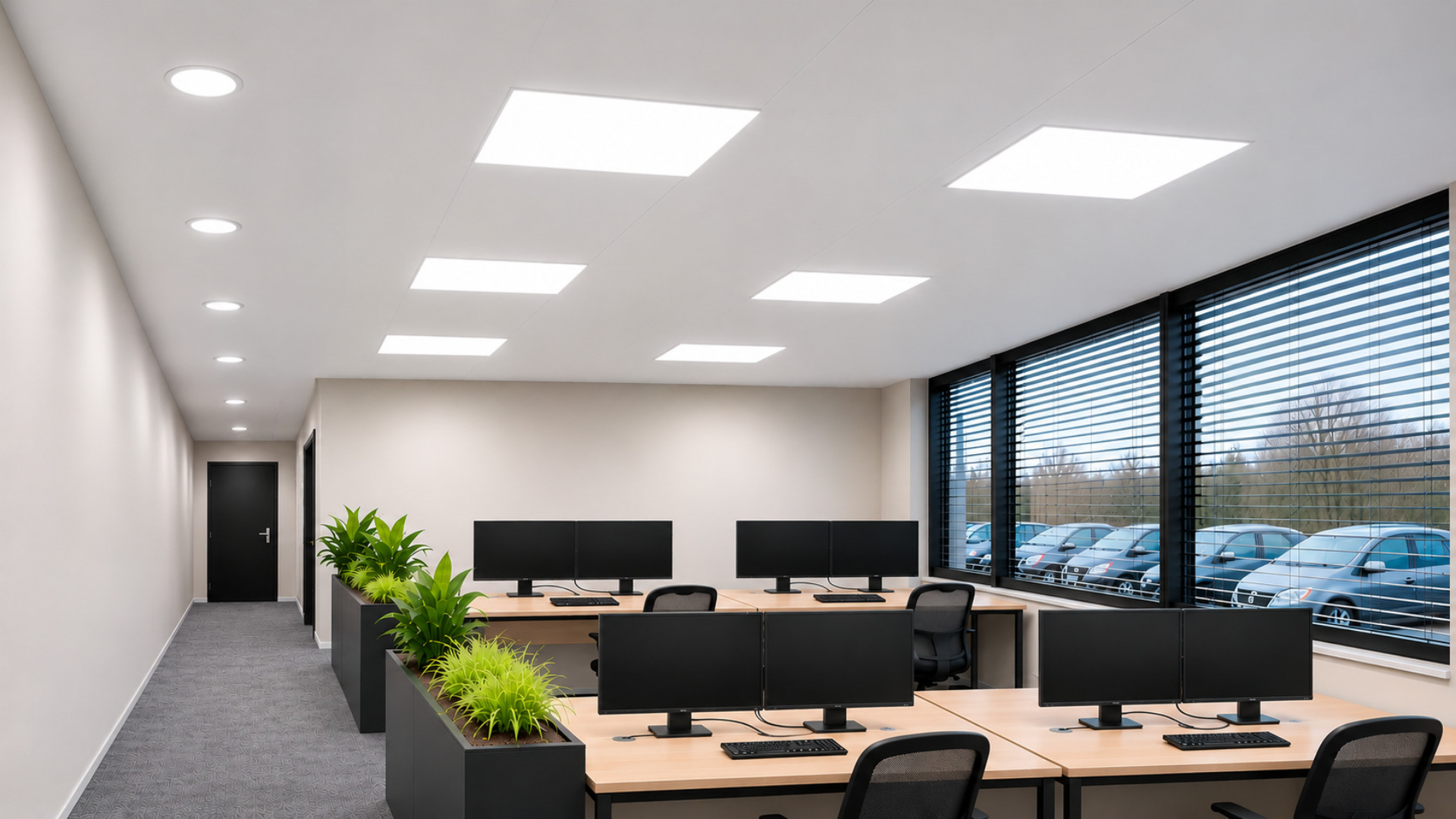
Downlights are a popular choice for lighting offices, workspaces and other areas. They provide a clean, modern appearance and offer various options in terms of colour temperature, light output and light distribution.
When choosing the right downlights, specifications such as lumens, colour temperature, IP rating and cut-out size play an important role. In this blog, you'll learn what these specifications mean and how to choose the right LED downlights.
Downlights are recessed light fixtures that direct light mainly downwards. They can be installed in suspended ceilings, creating a neat finish and a modern appearance.
Downlights are widely used in offices, corridors, shops and reception areas. They are available in various designs, including fixed, adjustable and dimmable models.
When choosing downlights, you should mainly consider the light output, measured in lumens. The higher the number of lumens, the more light the fixture produces.
Wattage indicates how much energy a downlight consumes. By comparing lumens with wattage, you can determine its luminous efficacy, expressed in lumens per watt.
The amount of light required depends on the size of the room, ceiling height and activities performed. For example, an office or workshop generally requires more light than a corridor or reception area.
Would you like to know more about how much light you need? Read our blog: How much light do I need?.
Colour temperature determines how warm or cool the light appears and is measured in Kelvin (K). The right colour temperature depends on the function and desired atmosphere of the space.
At 2700K, you get extra warm white light, suitable for welcoming reception areas and hospitality venues. A colour temperature of 3000K provides warm white light and is ideal for reception desks and waiting rooms. For offices, meeting rooms, workshops and warehouses, 4000K is a good choice. This neutral white light provides bright, functional illumination. At 6500K, you get cool daylight white light, suitable for specific tasks where very bright lighting is required.
Some LED downlights feature an adjustable colour temperature (CCT), allowing you to adapt the lighting to different activities and the desired atmosphere.
Would you like to learn more about colour temperatures? Read our blog: The right colour temperature for every workspace.
The IP rating indicates how well a downlight is protected against dust and moisture. The first digit represents protection against dust and solid objects, while the second indicates protection against water.
For dry offices, meeting rooms and corridors, IP20 is usually sufficient. In areas where splashing water may occur, such as washrooms and commercial kitchens, IP44 may be suitable. For workshops and warehouses where dust and moisture are present, IP54 offers additional protection. IP65 is completely dust-tight and protected against water jets, making it suitable for damp production areas and other demanding environments.
Would you like to learn more about the different protection ratings? Read our blog: What is the IP rating of a lamp?.
The cut-out size is the diameter of the hole required to install a downlight in the ceiling. It is measured in millimetres (mm).
When replacing existing downlights, the cut-out size must match the existing ceiling opening. For example, if the hole is 150 mm, choose a downlight suitable for this size. For new installations, you can select the fixture first and then create the required opening.
Also consider the recessed depth. This is the space required above the ceiling to accommodate the downlight and any separate driver.
Dimmable downlights allow you to adjust the brightness according to the activities and use of the space. For example, you can choose brighter lighting while working and lower light levels during presentations or meetings.
Not all downlights are dimmable. Therefore, always check whether the fixture supports dimming and whether the dimmer is compatible with the LED downlight.
Are you looking for suitable lighting for your office, workspace or commercial building? View all downlights.
Are you an installer or planning the lighting for an entire commercial building? Explore our solutions for professionals and installers.


