


The right work light depends mainly on the size of the area, where you want the light to come from and whether the lighting will be used temporarily or installed for a longer period. Working in a dark room, on a construction site in winter or outside in the evening? The right site lighting can make a big difference to how safely and accurately you work.
In this blog, we compare four types of site lighting: portable LED work lights, tripod work lights, LED floodlights and LED Strip Lights on Reel. For each type, we explain when it is the best choice.
Before choosing a type of work light, it helps to compare a few key features:
Light output (lumens): the higher the lumen output, the more light the lamp produces. With LED lighting, lumens therefore tell you more about actual light output than wattage alone.
Colour temperature (Kelvin): site lighting is often available in neutral white or cool white, for example 4000K or 6500K. 4000K provides bright, neutral light, while 6500K has a cooler appearance.
IP rating: the first number indicates protection against dust and the second against water. An IP65 work light is dust-tight and protected against water jets, making it suitable for many indoor and outdoor applications.
Light distribution: do not only look at how much light a lamp produces, but also how that light is spread. A portable work light mainly illuminates one work area, while an LED strip light distributes light over a longer distance.
Positioning and power supply: do you need to move the light regularly, place it on a tripod or mount it permanently? Also consider whether you want a mains-powered light or a rechargeable battery model.
A portable LED work light is a practical choice for temporary lighting at a single work area. You can quickly place it where light is needed and aim it directly at the work surface using the adjustable frame. The carry handle also makes it easy to move the light between rooms or job sites.
Work lights are available with different power levels and light outputs. A small room needs fewer lumens than a large workshop or outdoor job. Working outside or in a dusty environment? Choose a model with a high IP rating and also check the power cable length.
Painting, plastering and finishing work in one room
Jobs in a garage, shed or loft
Outdoor work, such as in a garden or on a driveway
No socket nearby? A rechargeable battery work light may be the better choice. Pay particular attention to battery runtime.
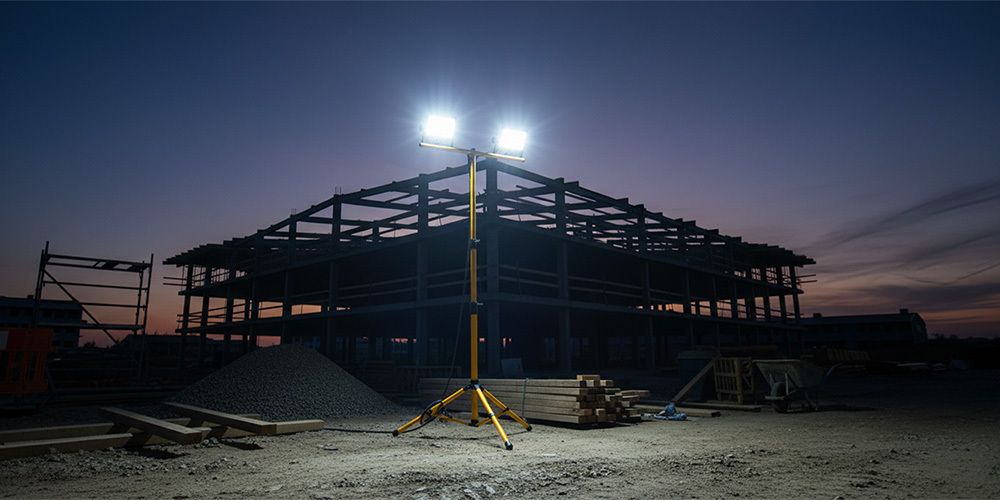
A tripod work light is useful when you want to illuminate a larger area from above. This helps reduce shadows caused by your own body, scaffolding or other materials while you work.
Many tripod lights have two lamp heads that can be aimed separately. This allows you to illuminate a ceiling and a wall at the same time, for example. Because the tripod is height-adjustable, you can adapt the light to the job.
Plastering or painting ceilings
Larger rooms during shell construction or renovation
Work areas where light is needed at height, for example when installing window frames
An LED floodlight is mainly suited to lighting that stays in the same place for a longer period. Unlike a portable work light, a floodlight is usually fixed in place, for example on a facade, pole or site cabin.
LED floodlights range from compact models for smaller areas to powerful versions for large sites. For outdoor use, a high IP rating such as IP65 or IP66 is important. Some models also have a motion sensor, so the light switches on automatically when movement is detected.
Construction sites, storage areas and site cabins
Yards, car parks and warehouses
Security lighting around a building
Many LED floodlights are hard-wired to the mains. If you are unsure, have the installation carried out by a qualified electrician.
An LED Strip Light is useful when you want to distribute light over a longer distance. It produces light along its full length and, depending on the model, can provide 360° light distribution. This allows you to illuminate a long area instead of relying on a single central light source.
LED strip lights are available in different lengths. Some models can be extended with an extension section, allowing you to adapt the length to the job without buying a completely new set.
A high IP rating is important for use on a construction site. A switch on the cable is also useful, allowing you to turn the light on and off without unplugging it each time.
After the job, roll the LED strip light back onto the reel. This keeps it compact for storage and makes it easy to take to the next location.
Construction sites and shell construction, for example along walkways and scaffolding
Temporary lighting in warehouses during renovation
Roadworks and outdoor work in the evening
Event sites during setup and dismantling
Situation | Best choice | Why | Positioning |
|---|---|---|---|
Painting or plastering walls | Portable LED work light | Directed light close to the work surface | On the floor |
Finishing ceilings | Tripod work light | Light from above and fewer shadows |
For larger projects, one type of lighting is not always enough. For example, you can use floodlights for the site, an LED strip light for long walkways and portable work lights for individual work areas.
There is no single work light that is best for every job. Focus on how much area you need to illuminate, where the light should come from and whether the lighting needs to be moved regularly or stay in one place for longer.
Then compare the light output, light distribution, IP rating, power connection and any cable length between the different options. This will help you choose lighting that suits the space, the work and the conditions on site.
At height
Large room during renovation | Tripod work light | Illuminates a large area | At height |
Work area without a socket | Rechargeable work light | Runs on battery power | Flexible |
Construction site or site cabin | LED floodlight | High light output over a large area | Fixed mounting |
Walkway or warehouse during renovation | LED Strip Light on Reel | Light distributed over a long distance | Rolled out |


